Displaced Palestinians live in makeshift tents at the al-Yarmouk displacement camp in Gaza City on October 20, 2026, after fleeing their homes due to the war. Families face difficult living conditions amid shortages of humanitarian aid and challenges in accessing adequate shelter, drinking water and basic services.
Displaced Palestinians gather for free meals and receive WFP food parcels in the Nuseirat refugee camp in the central Gaza Strip on October 20, 2026, amid worsening food insecurity caused by the war. The World Food Programme announced cuts due to funding shortages, reducing monthly beneficiaries from 1.6 million to 1.1 million and daily hot meals from 250,000 to 150,000, while around 1.4 million people in Gaza face crisis-level or worse acute food insecurity.
Two-and-a-half-year-old Maryam Ganem receives treatment for burns at al-Shifa Hospital in Gaza City on October 15, 2026, as relatives stay by her side. She was orphaned when her family was killed in an Israeli army attack on a residential building in Gaza City, which also left her with burn injuries.
Maha Radwan al-Shanbari, 47, struggles to continue her life inside a damaged home in the Nuseirat refugee camp on October 12, 2026, after losing her left leg when an Israeli missile hit her house on August 20, 2025. She has undergone four surgeries and says shortages of medicines and supplies are hindering her treatment, while she needs to travel outside Gaza for specialized care.
Students attend classes inside tents at the Saraya education point on October 11, 2026, sitting on the ground in temporary classrooms without desks or school furniture. According to educational estimates, about 90 percent of schools in the Gaza Strip have been destroyed or damaged during the war.
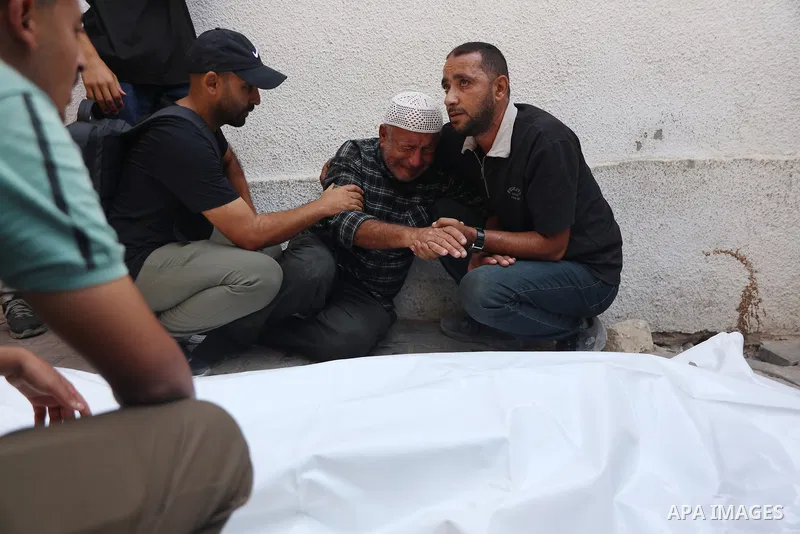
Palestinians mourn beside the bodies of their loved ones at al-Shifa Hospital in Gaza City on October 10, 2026, after they were killed in an Israeli attack. The attack comes as the Israeli army continues its strikes across the Gaza Strip despite a ceasefire.
Umm Maher al-Buraim waits in a shelter for displaced people in Khan Younis on October 7, 2026, for news of her son Maher, missing since 2024, after about 1,000 days of searching. Reports, including figures documented by a human rights body, estimate that more than 11,200 people are missing or forcibly disappeared in Gaza, including more than 4,700 women and children.
Palestinians took part in a mass funeral on October 1, 2026, for 105 people whose remains were recovered from beneath destroyed buildings in the al-Taj area of Gaza City's al-Yarmouk neighborhood. The victims, including women and children, were killed in Israeli airstrikes in the early stages of the war, and their remains had been trapped under the rubble for years.
Displaced Palestinians carry out daily activities among tents set up inside the campus of the Islamic University in Gaza City on September 21, 2026. The university, heavily damaged by Israeli strikes during the war, has been turned into a temporary shelter for hundreds of displaced families living in harsh conditions.
Kanaan Abu Jibba, the only surviving member of his family after an Israeli strike on their Shujaiya home killed his father, mother and sisters, writes in his notebook inside a tent in Gaza City on September 21, 2026. His left hand was amputated, and he now lives with his grandmother and uses a prosthetic limb as children in Gaza begin a new school year under harsh conditions.